
Château de Tourreau, Provence: a guide for photographers, videographers and planners
Our practical guide to Château de Tourreau in Provence: how to get there, how its avenue, salons and gardens photograph, how a wedding day flows, and the French rules on drones and marriage, from our own workshops at the château.
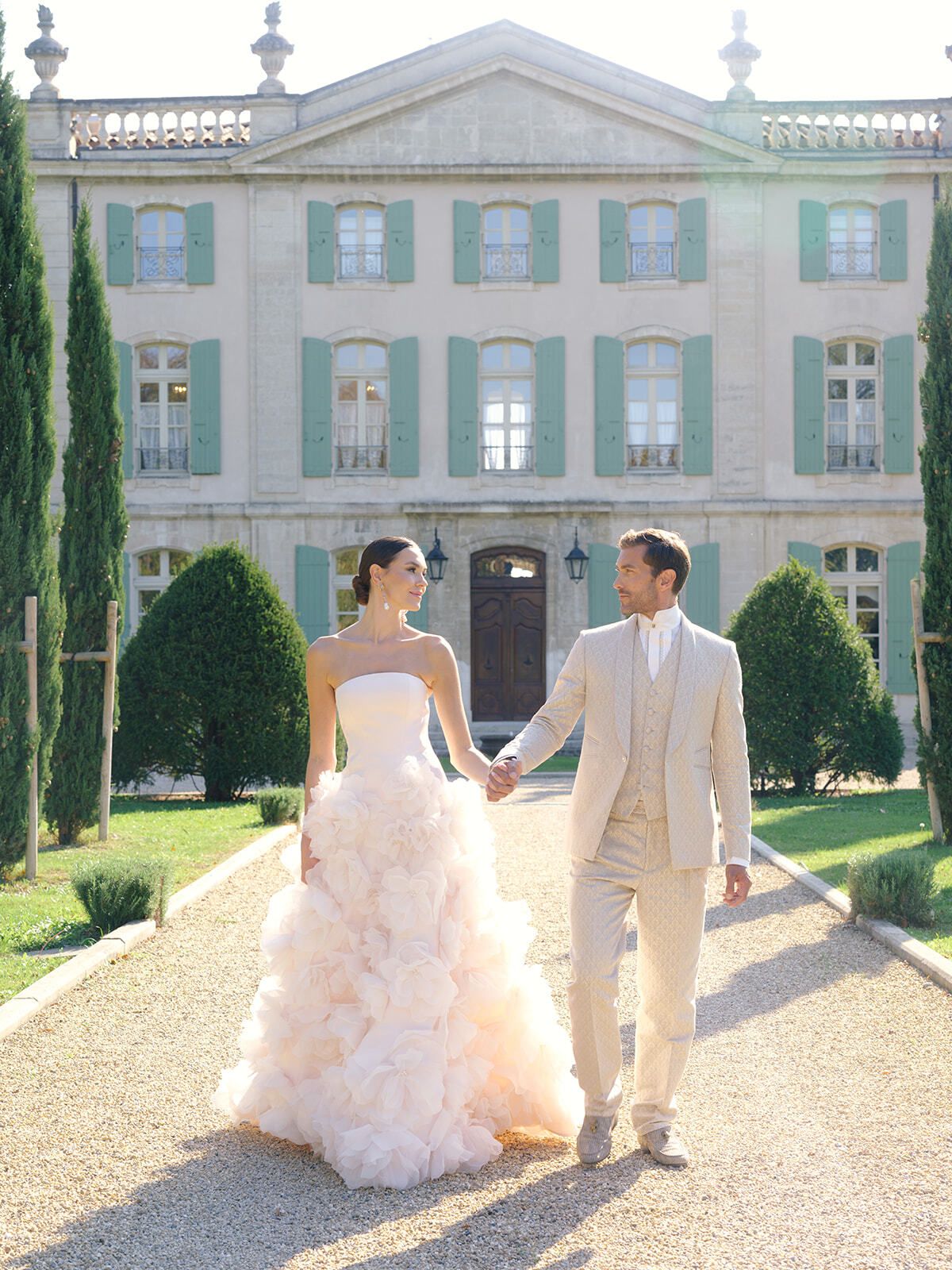
Château de Tourreau is an 18th-century château in Sarrians, in the Vaucluse heart of Provence, known for its cypress-lined avenue, formal French gardens, grand salons and a private chapel. For couples it is one of the most elegant places to marry in the south of France. For wedding photographers, videographers and planners it is a complete wedding story in one estate: getting ready in the salons, a first look on the avenue, a ceremony in the gardens and dinner in the park, all within its gates.
This is our guide to Château de Tourreau, written from the wedding workshop we held there in October 2024 and the one we return with in April 2027. It covers how to get there, how each space photographs, how a wedding day flows, and the practical French rules that matter on the day: drones, legal marriage and invoicing across borders. It is our own guide, not the château's site: for weddings and private bookings, contact the château directly (details below).
Where is Château de Tourreau, and how do you get there?
The château stands in Sarrians, between Avignon and Carpentras. According to its listings, it is about 30 minutes by road from Avignon and about an hour from Marseille Provence airport. For most international teams the simplest route is a flight into Marseille or a high-speed train to Avignon TGV, then a hire car: the villages and vineyards around Sarrians are part of the reason to come, and a car lets you scout them at golden hour.
For our workshops, participants arrange their own travel, accommodation and transport to the château. If you are photographing or planning a real wedding there, build in a full scouting day before the event; Provençal roads are slower than the map suggests, and the light changes the estate completely from morning to evening.
What makes Château de Tourreau special for weddings
The château was built in the mid-18th century for the Tourreau family, and its façade, roof, chapel building, tree avenue and rear garden parterre have been listed as a historic monument since 1963. That listing is visible in every frame: the symmetry, the pale stone, the avenue running straight to the door.
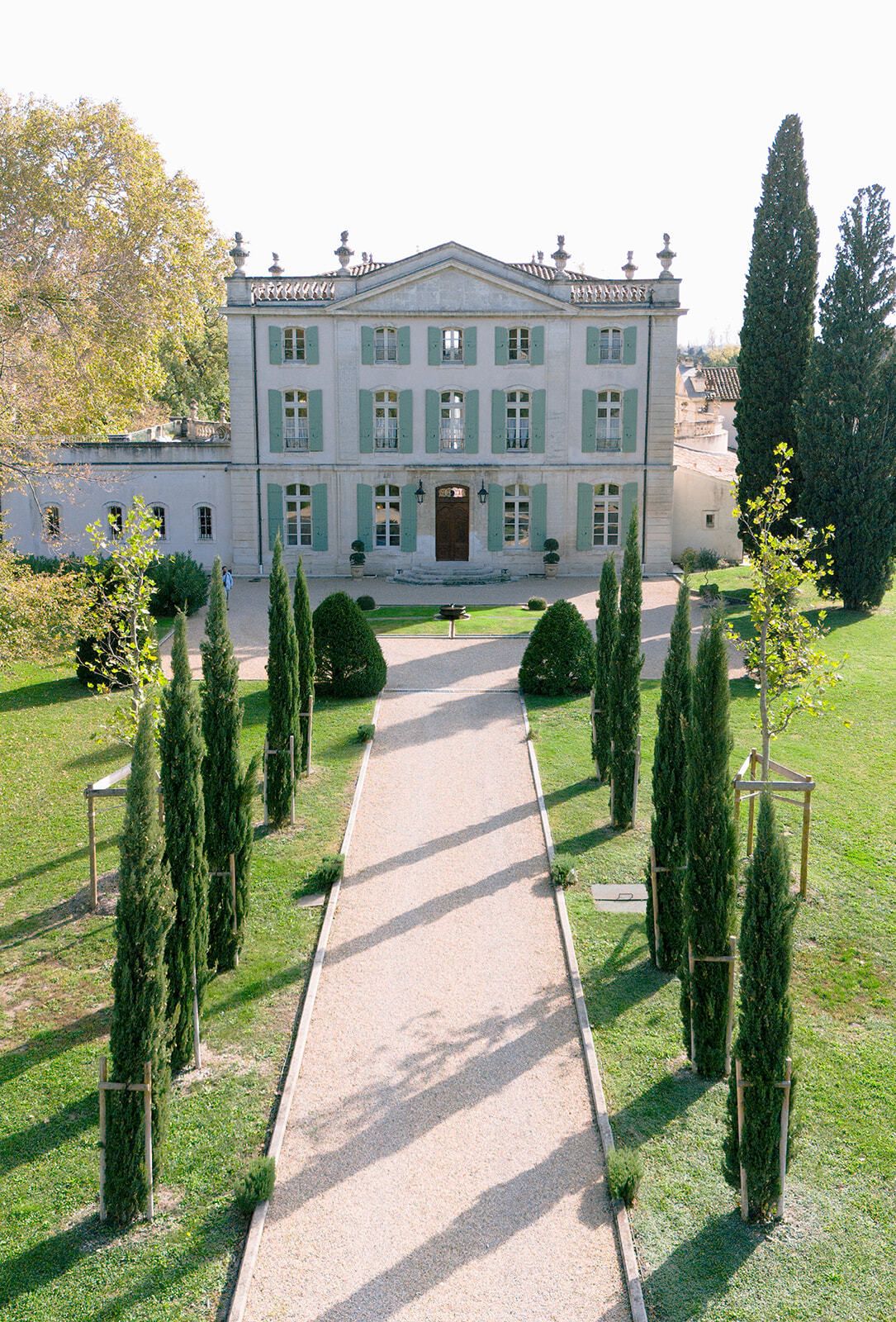
The cypress avenue and the façade
The avenue is the signature view. Shot from the ground with a long lens, it gives depth and strong lines for a couple walking towards the camera; from above, it places the whole estate in the landscape. The façade behind it works for the first look and for formal portraits, and it photographs beautifully in soft side light.
The salons and the staircase
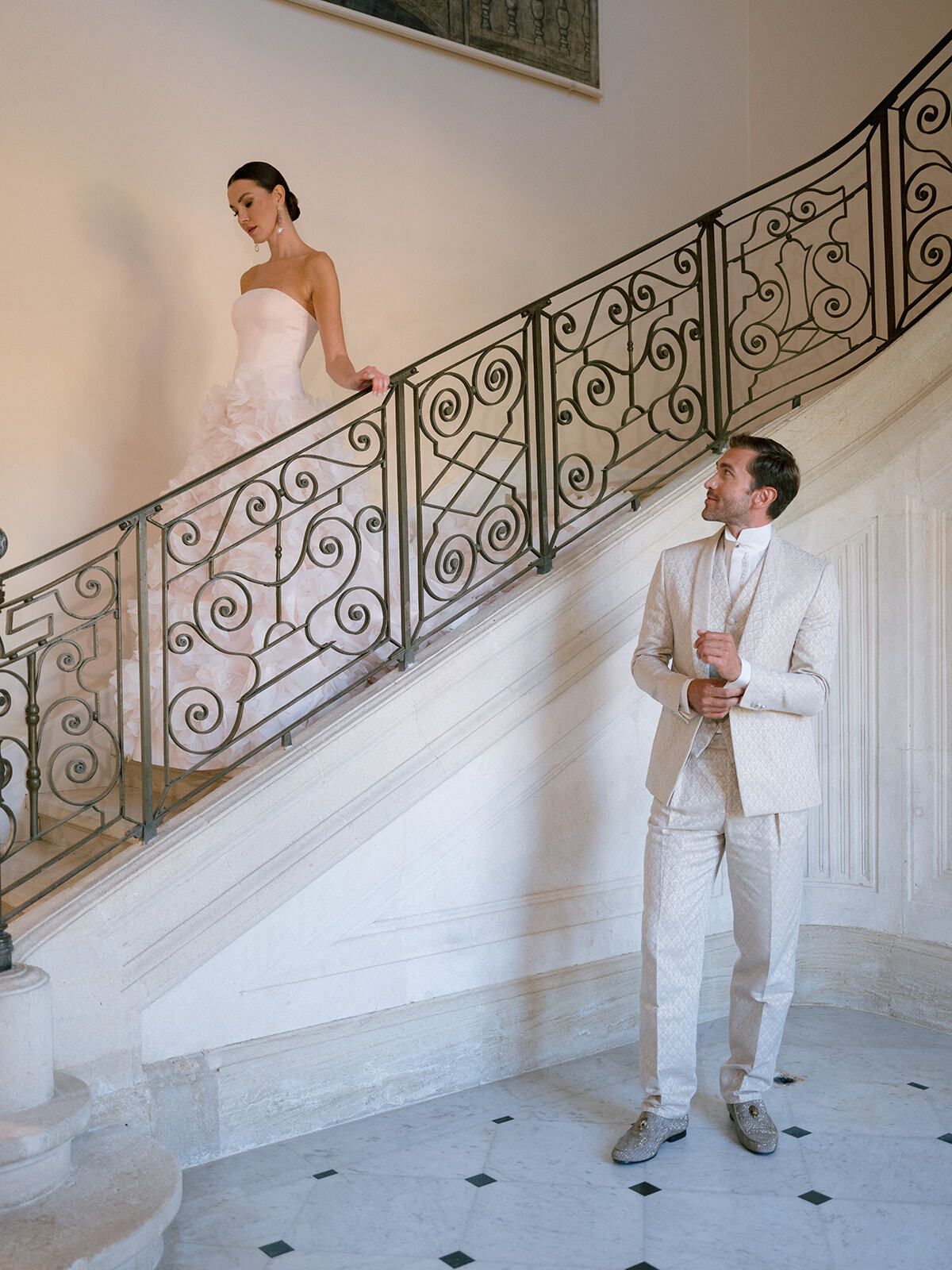
Inside, the château offers grand salons with tall French windows and a wrought-iron staircase that is one of our favourite places for couple portraits: the bride above, the groom below, the curve of the railing between them. The rooms carry the getting-ready story for both sides, with window light doing most of the work.
The chapel
The estate has a private chapel dating from 1614, older than the château itself, which seats around 70 guests according to the venue's listings. It suits an intimate religious or symbolic ceremony, with the reception moving outdoors afterwards.
The gardens, the reflecting pool and the pool
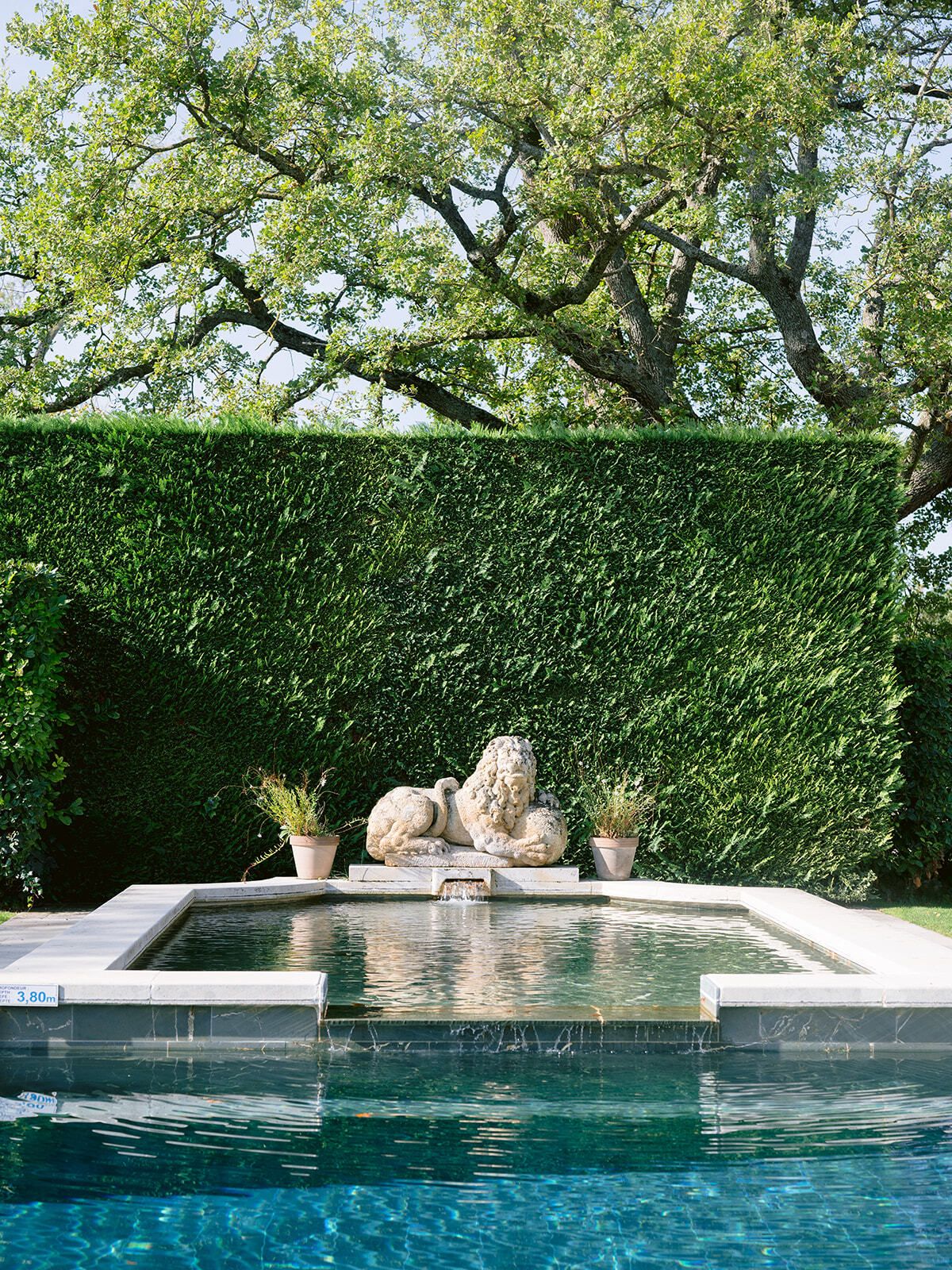
Behind the château lie formal gardens, a reflecting pool and a swimming pool framed by tall hedges and stone lions. The pool area is where we staged the champagne celebration in 2024: bright, sunny and relaxed, a complete change of pace from the formal salons. The park under the trees holds long reception tables for a garden dinner.
Planning a wedding at Château de Tourreau: notes for planners
Exclusive use, with guests on site. The château is hired privately for weddings and sleeps 29 guests across the château suites and a renovated farm building, so the couple and their closest guests can stay on the estate. Its listings give outdoor capacity for around 150 seated guests.
Minimum stay. The château's listing on French Wedding Style gives a three-night minimum in peak season (June to September). Confirm current terms and rates directly with the château.
Suppliers. The same listing says external caterers are allowed, with recommended caterers available; florists, furniture hire and planning are arranged separately. That makes it a strong venue for planners who work with their own trusted team.
Legal marriage happens at the town hall. In France a legally binding marriage must be celebrated at the mairie of a town where one partner, or one of their parents, has lived for at least a month before the banns are published, and the banns must be posted for ten days first. Most international couples therefore marry legally at home and hold a symbolic ceremony at the château, led by a celebrant. Explain this early, as it shapes the ceremony script and the timeline.
Plan for the mistral. The mistral, Provence's strong northerly wind, is most common in winter and spring and often blows for several days at a time. For a spring wedding, have a sheltered plan for the ceremony, weight tall floral pieces, choose hurricane glasses for candles, and keep a second veil-friendly portrait location in the lee of the château.
A château wedding day in Provence, in order
At our April 2027 workshop we recreate a complete wedding day at Château de Tourreau, and the order we follow makes a useful template for a real wedding there:
1. The bride getting ready inside the château, with the groom's preparations in parallel
2. Details: stationery, rings, accessories, florals and flat lays
3. The first look around the château and gardens
4. Couple portraits on the avenue and in the gardens
5. Ceremony styling, then the ceremony and vows
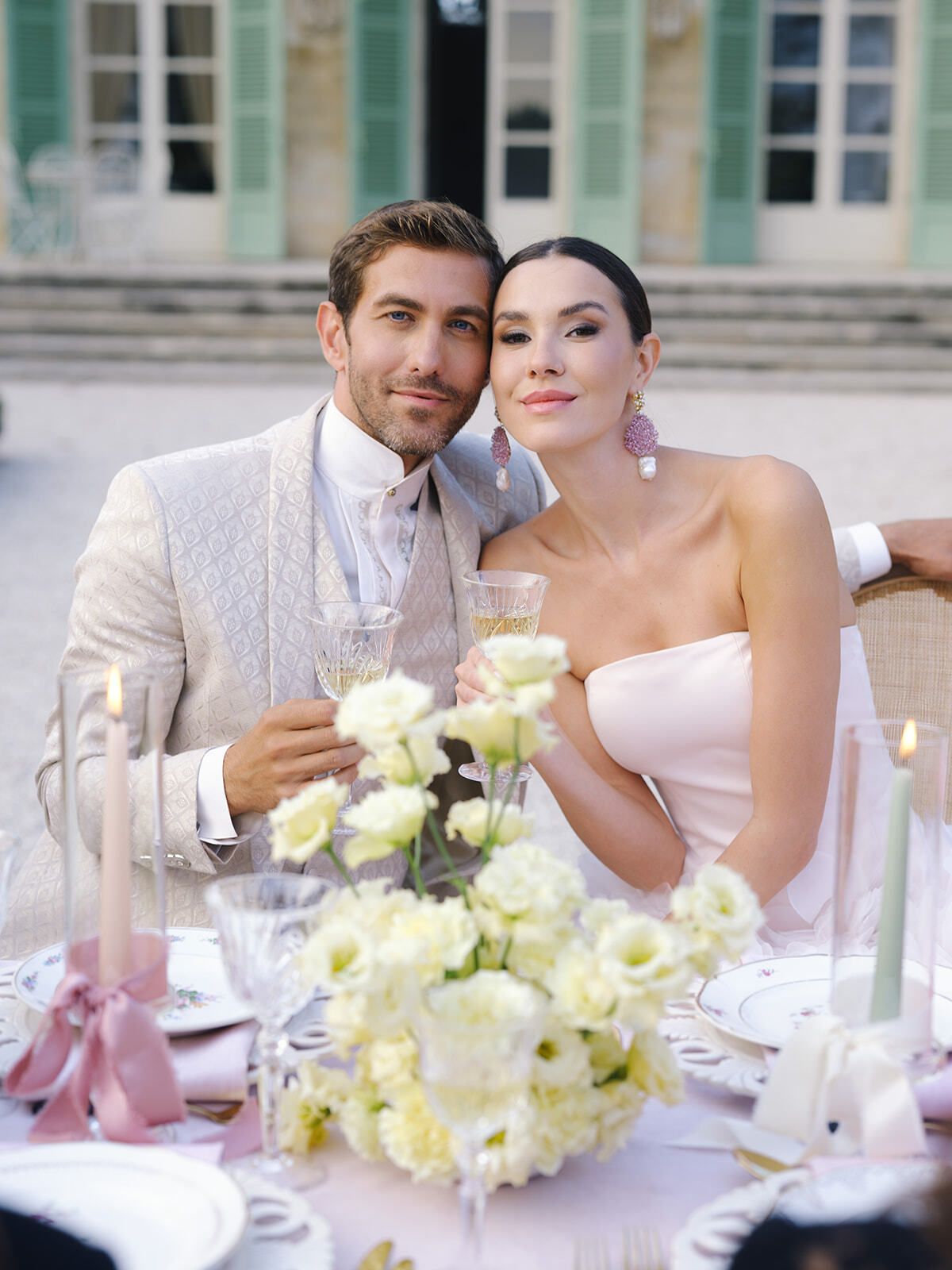
6. Reception styling: the wedding table and dinner set-up
7. The celebration, with a champagne tower
The logic is simple. Interiors first, while the gardens are being dressed; the first look and portraits before guests arrive; the ceremony and reception as the light softens. In late April the sun sets after 8 pm in Provence, which leaves a long, gentle evening for the reception.
Photographing and filming Château de Tourreau
Light and seasons
Spring brings fresh green gardens and soft light; autumn, when we first worked here, turns the trees around the reflecting pool gold and gives warm, low sun through the afternoon. In both seasons, avoid putting the couple on the open avenue in the middle of the day: the pale gravel and stone reflect hard light. Use the salons and the shade of the hedges then, and save the avenue for the last two hours before sunset.
Show the château, not just the couple
The images clients remember show where they were: the façade behind the couple, the cypresses leading to the door, the stone lions by the pool. Step back and include the architecture in at least part of every sequence. Our luxury wedding photography shot list is a good checklist for making sure the venue is in the story.
For videographers
The avenue is made for a slow walk towards the camera, and the staircase for a vertical reveal. Record ambient sound in the gardens (birdsong, water, gravel underfoot); it carries a Provence film better than any music cue.
Flying a drone at a wedding in France
A drone shot of the avenue is the image most couples want, and France follows the EU drone rules. In the open category, which covers most wedding work including paid jobs:
- Register. Operators register with the French civil aviation authority (DGAC) on its AlphaTango portal and receive an operator number to display on the drone. Drones of 800 g or more must also be registered and broadcast an electronic identification signal in flight.
- Train. Pass the online "A1/A3 open category" course and test (40 questions, 75% to pass); the certificate is valid for five years.
- Fly within the limits. Maximum 120 m above the ground, never over people or vehicles, and never over a gathering, which means no passes over the ceremony or the dinner tables. No night flights, so plan the drone for daylight.
- Check the map and ask permission. Check the official Géoportail map of flight restrictions before you travel, get the château's agreement, and make sure guests who can be identified in the footage are happy to appear in it.
Working in France as an international wedding professional
Invoicing a French planner or agency. If you are VAT-registered in another EU country and invoice a French VAT-registered business, the reverse charge (in French, autoliquidation) usually applies: invoice without French VAT, show both VAT numbers and add the "Autoliquidation" mention. Invoicing a couple directly follows different rules, so confirm with your accountant.
Travelling from outside the EU. France is in the Schengen area. Check the EU's official travel site before you book, as the new Entry/Exit System registers non-EU travellers at the border and the ETIAS travel authorisation is due to follow.
Contracts. Put the venue's rules, the drone plan, the weather plan and the delivery timeline in writing with the planner or couple. At a historic, listed estate, the venue's rules on access, set-up and candles come first.
Our Château de Tourreau workshop in April 2027
We return to Provence on 28–29 April 2027 for wedding photographers, videographers, content creators and planners. On 28 April we recreate a full wedding day at the château, with a professional couple in luxury fashion, a styled ceremony and reception, and a champagne tower celebration. On the morning of 29 April Diana (Still Miracle) leads a live editing session, followed by a business conversation with our team on marketing, personal branding and the luxury wedding industry. Everyone receives the full vendor list afterwards.
Participants work in small groups of 4–5 with creative direction all day and individual time with the couple. Planners take part as professionals, building their portfolio and their network with photographers and videographers. The early-bird price is €2,850 until 30 November 2026 (regular €3,150), with a €550 deposit. Everything is on the Château de Tourreau 2027 workshop page, and planners can see what we offer them on our workshops for wedding planners page.
Booking Château de Tourreau
Weddings and private events at the château are booked directly with its owners through the official Château de Tourreau website. If you are a couple dreaming of a château wedding in Provence and would like us to design and plan it, our wedding brochure explains how we work, and our page on wedding venues in France shows the other châteaux we love.
Your next step
If you photograph, film or plan weddings, Château de Tourreau is one of the most rewarding places in France to build a destination portfolio, and our April 2027 workshop is a beautiful way to spend two days there. For our other dates, see all upcoming workshops.
Upcoming workshops
from €3,350
Dates & detailsfrom €1,150
Dates & detailsfrom €2,850
Dates & detailsParis
Early bird until 30 November
from €1,150
Dates & detailsChâteau de Tourreau
Early bird until 30 November
from €2,850
Dates & detailsVilla Balbiano
Early bird until 30 November
from €3,350
Dates & details
Questions
Where is Château de Tourreau?
In Sarrians, in the Vaucluse in Provence, between Avignon and Carpentras: about 30 minutes by road from Avignon and about an hour from Marseille Provence airport.
Can you legally get married at Château de Tourreau?
In France, legal marriages take place at the town hall where one partner or a parent has lived for at least a month. Most international couples marry legally at home and hold a symbolic ceremony at the château.
Can I fly a drone at a wedding in France?
Yes, within the EU open-category rules: register with the DGAC, pass the A1/A3 online test, stay under 120 m, never fly over people or gatherings, fly in daylight only, and get the venue's permission.
When is the next Château de Tourreau workshop?
28–29 April 2027: a full wedding day at the château on 28 April, then live editing with Diana and a business session on the morning of 29 April. Early-bird prices run until 30 November 2026.